
Successful Story of Autistic Child
F.F, an 8-year-old child diagnosed with Autism Spectrum Disorder (ASD), is example of how early intervention and consistent therapy can bring positive transformation in the life of a special child. His journey from being a withdrawn, non-verbal child to someone who now responds to commands, expresses emotions, and participates in daily tasks is nothing short of inspiring. This success story focuses on F.F improvements, particularly in command following and behavioral development after receiving ABA (Applied Behavior Analysis) , Occupational Therapy (OT), Speech therapy and Learning Classes
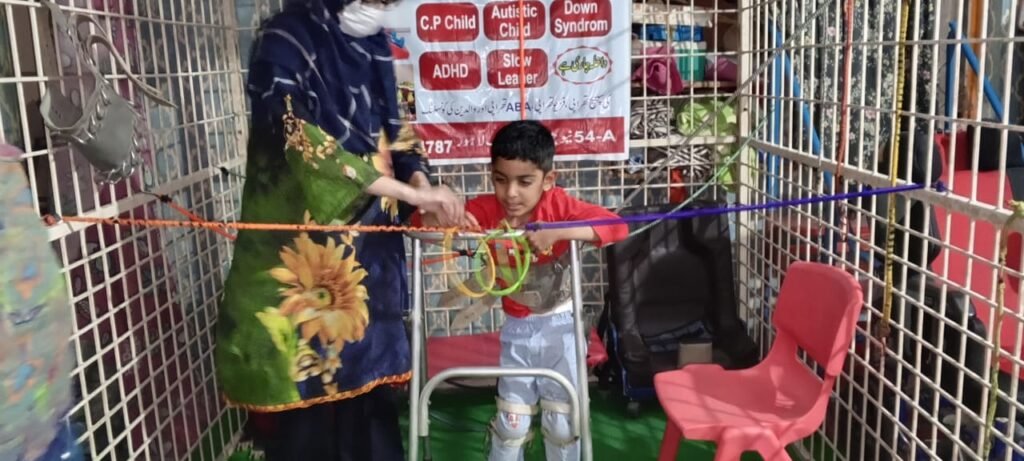
Initial Concerns and Diagnosis
F.F’s parents began to notice developmental delays when he was around 5 years old. He exhibited no eye contact, lacked verbal communication, and often showed signs of aggression and impulsivity behavior, hitting himself Despite efforts at home, he struggled with basic routines, didn’t respond to his name, and failed to follow even the simplest commands. His emotional regulation was weak; frustration often led to tantrums or physical aggression.
Concerned, his parents consulted a children hospital, who confirmed that F.F fell within the autism spectrum. The diagnosis came as a shock but also provided clarity. They were advised to begin therapy as soon as possible.
Beginning of the Therapy Journey
F.F was enrolled in a Mother and Child Rehabilitation Society an institute for special needs Children where he began ABA therapy combined with Occupational Therapy and Speech Therapy. The focus was on behavior modification, command following, sensory integration, and self-help skills. Initially, progress was slow. He resisted interaction, refused tasks, and often became overwhelmed in new environments.
The therapists used reinforcement strategies to shape desired behaviors like high fi, clapping, Simple one-step commands such as “Sit down,” “Come here,” and “Give me” were practiced daily. Occupational therapists worked on his sensory sensitivities and motor coordination to help him become comfortable with structured environments.
Progress Over Time
Within three months continuous therapy, small changes began to appear. F.F started maintaining brief eye contact and responded occasionally to his name. His therapists noticed that when commands were delivered clearly, with visual cues and rewards, Faiq was able to follow them more accurately.
Six months into therapy, Faiq showed a remarkable improvement in command following. He could understand and perform two-step commands such as “Pick up the toy and give it to me” or “Go to the sink and wash your hands.” He also began to follow classroom routines with minimal prompts. His impulsive behavior reduced significantly, and instead of reacting aggressively, he began to wait, observe, and respond when cued.
Home-Based Generalization
One of the most important aspects of Faiq’s journey was the parental involvement. His parents were trained by therapists to implement behavior techniques at home. They created a structured daily routine using visual schedules and reinforced positive behaviors through reward systems. As a result, Faiq began following commands outside the therapy environment as well.
For example, his mother proudly shared how she could now say, “Faiq, bring your shoes,” and he would go, find them, and bring them back. Tasks like brushing teeth, putting toys away, and coming to the table for meals became routine with fewer reminders.
Social and Emotional Improvements
Faiq also began developing social awareness. Though verbal communication is still developing, he has started to express himself through gestures and limited speech. He can now respond to greetings, follow instructions in playgroups, and participate in small group activities.
His emotional regulation has also shown progress. Previously, small changes in routine would result in severe meltdowns. Now, Faiq can tolerate transitions better and recovers faster from upsets. His improved ability to follow commands contributes greatly to this regulation, as he now understands what is expected of him in different situations.
Current Status and Ongoing Goals
Today, Faiq is a more engaged, responsive, and happier child. His command following has improved to such an extent that he can independently follow a series of instructions at home and in therapy. He is also learning to ask for help, follow classroom rules, and communicate needs effectively.
While there is still a journey ahead — particularly in language development and academic readiness — Faiq’s progress is a clear testament to the power of early intervention, structured therapy, and parental dedication.
Conclusion
F.F’s story is a beacon of hope for parents and caregivers of autistic children. Through ABA and OT therapies, combined with love, patience, and consistency, F.F has overcome many challenges. His improved ability to follow commands, manage behaviors, and interact with the world around him is a source of pride and inspiration. His journey reminds us that every child has potential — they just need the right support to unlock it.